Presentation:
Peter Piccone
Connecticut Department of Energy & Environmental Protection
"Sessions Woods Wildife Management Area"
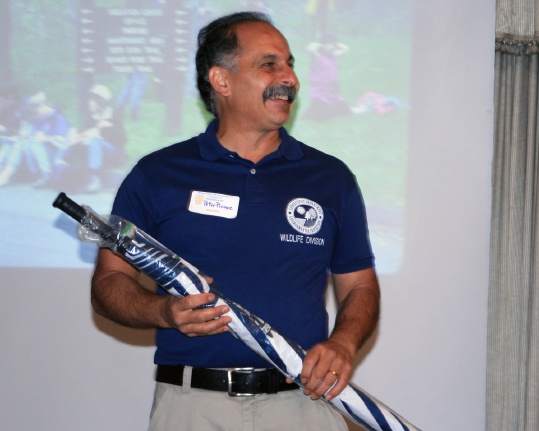
Mr. Picone accepts a 2016 Rotary Club of Avon-Canton golf umbrella on behalf of his department.
Arnie Goldman introduced, Peter Picone, who shared a short biography explaining how he came to do the work he was soon to share with us. He grew up in Connecticut, and worked on a farm as a youth, where he came to learn about plants while exploring the farmland, thus developing a love for the outdoors. He attended UConn where he pursued a career in natural resources, in which he has now been employed for 30 years. He spent 5 years at the Connecticut Agricultural Experiment Station in New Haven (http://www.ct.gov/caes/cwp/view.asp?a=2836&q=378206) and thereafter 25 years with the Connecticut Department of Energy and Environmental Protection, DEEP (http://www.ct.gov/deep/site/default.asp) in their Sessions Woods Wildlife Management Area (SWWMA).
SWWMA started out as a 400 acre tract purchased from private hands with money obtained from the federal "Pittman-Robinson Act", of 1937.
Sara Pittman and Sara Robinson requested to be "self taxed" to buy land for land preservation purposes. Few know that 11% of gross sales of hunting related equipment and supplies (including firearms and ammunition) are captured for the use of land management. To date 800 million dollars have been collected and utilized in this way.SWWMA has received their portion for hunting safety and land preservation and management purposes. The 75% of their funding obtained through Pittman-Robinson is matched by 25% provided from state sources. This is a good example of a "user pay system." It is also important to know that some funding is expended on non-hunting, land management matters such as black bear issues. With no hunting season on bears in Connecticut, they have proliferated to the point that human-bear conflicts inevitably arise. Today SWWMA is 764 acres, the original 450 acres purchased under Pittman-Robinson and 333 additional acres obtained with resources from the general fund.
Especially good news to Mr. Picone is the natural wildlife replenishment that has occurred on during his tenure. When he began with SWWMA there was just one bald eagle in Connecticut and now there are at least 50 nests that have been counted in recent years. He noted that this time, our time, is th ebest time to be alive in the "wildlife business." There are once again Ospreys on the Quinnipiac River, as their population has recovered, and there has never before been so many people enjoying wildlife as there are right now. Mr. Picone's passion for his work was clear and his ability to convey that passion evident!
Despite the reasons given for optimism, there remain two main threats to biodiversity: 1. Habitat loss and fragmentation and 2. Invasive, non-native species.
Habitat loss and fragmentation is a consequence of the changes in our economy and society over the last 100 years at least. At one time there were 1200 dairy farms in Connecticut but today just 150 remain. Though the loss of farms has resulted in mush more woods than Connecticut once had, some of the farmland was lost to residential and commercial development for human purposes. Mr. Picone emphasized that we cannot get more land from future farm abandonment and that 73% of undeveloped land remains in private hands, where much of it is at risk.
Invasive, non-native plant species are a persistent threat to native species, habitat and wildlife. There are 97 invasive plant species in Connecticut today and one, for example, the "mile-a-minute vine" grows and reproduces at incredible rates, outstripping native plant species ability to compete, and altering wildlife habitat as a result. We also have non-native wildlife species such as European sparrows and starlings which crowd and kill our Bluebirds.
The goals of the SWWMA include: 1. to maintain biodievrsity of the property using scientific principles and insights, 2. to educate the public on wildlife management techniques and 3. to provide recreation, enjoyment, wildlife watching and limited, permitted bowhunting on the property. SWWMA features several trails (Yellow: 3 miles, gravel; Pink: 1/2 mile, quick outing; Green: tree identification; Orange: passes through a "patch cut" created to favor the Cottontail and the Towhee). There is also a boardwalk through and past ponds and bird blinds. A bald eagle habitat and wild duck, bluebird and tree swallow boxes are provided. There are fishless ponds for salamander habitat, one of which is kept from human impact, and an observation tower from where Meriden mountain may be seen.
A private not-for-profit organization, "Friends of Sessions Woods" assists with refurbishing structures and other needs not proved for by state funding. The Sessions family, who owned a clock factory in Bristol, once also owned much of the land that is today SWWMA. Today 97% of SWWMA is forested.
In recent years, SWWMA forest resources have been formally inventoried and 21 unique stands evaluated. This allows forest management decisions to be made scientifically, an an amazing diversity of trees and shrubs to thrive.
While there are 2800 possible plants in Connecticut, just 1800 (64.3%) are native with 1000 (35.7%) being non-native. Of these 1000, 97 are considered invasive.
Planting is important for wildlife, and when we replanted the area surrounding our work facility we used natve species to encourage and support native wildlife. Habitat is the foundation for migratory bird survival during migrations, which number 400 species in Connecticut. Bird feeders with seed cannot substitute for appropriate habitat and the natural foods it provides.
Specific plant species that support native birds include the Woodland Sunflower, a perrennial which is an excellent habitat and food source. Others include Red Chokeberry and Black Chokeberry.
Native grasses such as Little Bluestem, Big Bluestem, Switch Grass and Deer Tongue Grass provide security and seed sources for native birds. Though these were once planted and harvested for hay, today other non-native farm grasses are often brought in which do not provide good habitat and food sources.
Of the 97 invasives, 13 are really nasty and may be found in SWWMA. One, Black Locust covered 18 acres at one time but since has been eradicated. One Black Locust plant is capable of producing 24,000 seeds. In the process of eradicating it from this particular stand, 20 cords of Black Locust wood was harvested and sold to the public and 65 more cords were milled for lumber. The profits derived were put towards the general cost of operating the SWWMA. The lumber is highly rot resistant, equivalent to pressure treated wood, and is also impact resistant, and as such is commonly used for boat frames and horse trailers. The remaining stumps were treated to prevent regrowth as well. Unfortunately, many other invasive plants have no viable use and must simply be eradicated.
In closing Mr. Picone invited all Rotarians to SWWMA to experience its beauty and value.
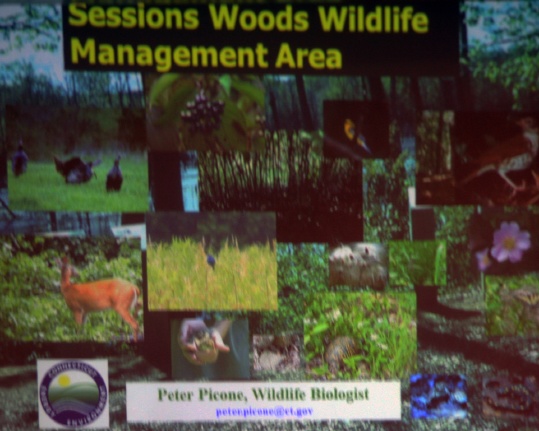
Mr. Picone's final slide including his email address, peter.picone@ct.gov.
###